Archives – April 28, 2025
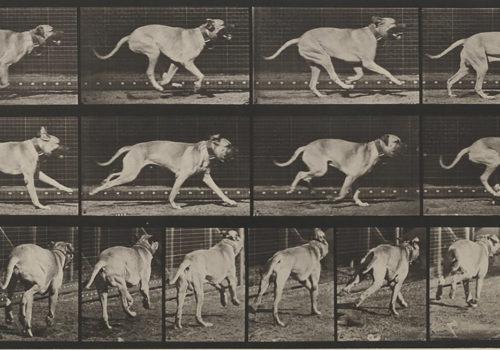
Eadweard Muybridge was born in England nine years before photography, which was presented to the Paris Academy of Sciences in 1839. He emigrated to the United States in the 1850s, first to New York, then to San Francisco. He began to make a name for himself as a landscape photographer of the American West, using the wet collodion process. From an early age, the ability to capture what escapes the human eye fascinated him. Today, he is considered a pioneer in the exploration of movement, which he succeeded in decomposing through the still image.
The starting point was a question posed by Leland Stanford (founder of the university of the same name): when a horse gallops, do all four legs lift off the ground at the same time? Muybridge took up the challenge and produced his series on the movement of horses on Stanford’s property in 1878. Twenty-four cameras equipped with collodion-emulsified glass plates were triggered when the animal’s movement activated a wire, breaking down the movement into individual images.
Photography has become a tool that has profoundly changed our understanding of the natural world, and Muybridge’s work represents a high point in research by immortalizing movement with his innovative techniques. Valentín Vallhonrat, the exhibition curator, tells us, “Muybridge achieved fractions of movement that challenged traditional conceptions, as in the case of his studies of the gait of horses. He opened up new possibilities for artists seeking to capture movement more faithfully. His work also laid the foundations for the invention of cinema, which revolutionized communication and entertainment in the 20th and 21st centuries.” Muybridge’s works paved the way for many painters and visual artists who sought to capture dynamics, influencing names such as Rodin, Degas, Duchamp, and Bacon. Muybridge’s legacy was also very important for sciences related to the human body, such as anatomy, biomechanics, and prosthetics, not to mention zoology and veterinary medicine. His photographs therefore constitute a link between art, knowledge, and science. These works were the origin of the invention of cinema, because, as the curator explains, Muybridge “included time in photography.”
The Museo Universidad de Navarra inaugurates this exhibition with a video projection and 56 photographs, selected from an album of 93. The exhibition is on loan from collectors Ernesto Fernández Holmann and Marta Regina Fischer, members of the family of the Patronato Promotor del MUN (Governing Council of the Museo Universidad de Navarra). The exhibitions are free throughout 2025, on the occasion of the tenth anniversary of the MUN, and thanks to the Pamplona City Council.
Jean-Jacques Ader
Eadweard Muybridge (1830-1904)
from April 2 to August 24, 2025
Museo Universidad de Navarra (MUN)
Pamplona ESP.
Torre Room
Curator: Valentín Vallhonrat and Ignacio Miguéliz.
Information: https://museo.unav.edu/