For la terre amoureuse (se dit de la terre qui colle aux bottes) [The Amorous Earth (a term used for soil that clings to your boots)], published by Rotolux Press, Rebekka Deubner spent three years immersed in the farming communities of Deux-Sèvres, in western France. Turning away from the images of violence that have come to define Sainte-Soline in the public imagination, she shifts the gaze towards what the confrontation left outside the frame.
In March 2023, Deubner took part in a protest organised by Les Soulèvements de la Terre against the construction of large artificial irrigation reservoirs, known in France as mégabassines. She brought her camera and made a few photographs in passing, without any real photographic intention, but chose not to pursue them further. The images already circulating widely in the media had reduced the struggle to clashes between protesters and the police. Rather than adding to this saturated iconography, she turned her attention to what the violence had pushed into the background: the distribution of water, competing agricultural models and the question of how to inhabit a territory without exhausting its resources.
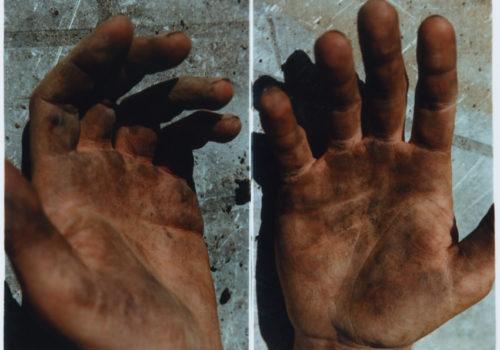
For nearly three years, Deubner returned almost every month to the Marais poitevin, following the daily lives of market gardeners, livestock farmers and activists. It was Rémi, whom she photographed harvesting leeks from waterlogged soil, who introduced her to the expression behind the project’s title: locally, the earth is said to be “in love” when it clings to your boots. She observes the gestures through which a landscape is shaped, and the ways in which bodies transform their environment while being transformed by it in return.
Sequences also structure her approach to the territory itself. Accustomed to looking at things from very close up, so that sight might summon other senses, she came up against what such proximity obscures: the legibility of a space. She therefore began photographing the landscape in fragments, like a tracking shot made up of still images. Placed side by side, they reassemble a field, a peat bog or a tree, allowing the eye to move through them as a body moves through a landscape. Each photograph remains incomplete, finding its continuation in the next.
All 460 images in the book are enlargements taken from contact sheets. The sequences often preserve the order in which the photographs were made, revealing Deubner’s own path through the territory. The pages turn to the rhythm of working bodies, animals, plants and seasons, in a flow occasionally interrupted by views of the mégabassines. Massive and silent, they break into this continuous movement, set apart from the mobility of bodies, water and living matter.
Although kept outside the frame, the struggle never disappears. It resurfaces through protest songs whose lyrics punctuate the book, providing moments of respite within its cinematic flow. Deubner drew them from the songbook of a choir based in Melle, a town in Deux-Sèvres. “In moments that can be quite violent and tense, singing brings people together; it creates breathing spaces, renewed motivation, sharing and release,” she explains.
Songs written specifically about the mégabassines appear alongside agricultural and historical revolutionary songs. Each is introduced by a short text explaining the circumstances in which it emerged, situating Sainte-Soline within a broader history of collective struggle. These lyrics allow activists to speak in their own words and enable ecological struggles to travel from one territory to another, much as Deubner relays the knowledge of those she encounters.
Rebekka Deubner does not replace images of violence with a pacified vision of rural life: she widens the frame. She reveals both what the confrontation left outside it and the reasons that continue to sustain the struggle. Rather than focusing on what people are fighting against, la terre amoureuse shows what they are fighting for.
Rebekka Deubner — la terre amoureuse (se dit de la terre qui colle aux bottes)
Published by Rotolux Press
230 × 165 mm
512 pages plus an 8-page insert
Four-colour offset printing, softcover with flaps, sewn and glued binding, inserted saddle-stitched booklet
Available online and from bookshops