Our exploration of the 2025 Swiss Photomonth continues with four exhibitions, some extending the photographic experience into 2026. After the contemplative and documentary approaches of our first selection, this second chapter turns toward more experimental practices.
Peggy Kleiber: From Shadow to Light, Photoforum Pasquart, Biel
At the Photoforum Pasquart in Biel, “Peggy Kleiber: From Shadow to Light,” on view until November 30, 2025, shows the photographic archive of Peggy Kleiber (1940–2015), an Italian teacher from Biel who, over more than three decades, produced an astonishing body of nearly 15,000 photographs. Never exhibited or published during her lifetime, these images of daily life, family scenes, streets, and travels now emerge in a first posthumous exhibition that questions the role of amateur photography in the history of the medium.
Working with a Leica M3, Kleiber documented her family environment, women at work in the Roggwil stamping factory, and her travels through Italy, Paris, Prague, and New York. Her lens focused especially on women portraits, factory life, domestic scenes. Some of these portraits possess a striking presence, revealing an intuitive photographic awareness, even though she never saw herself as a professional photographer. The rediscovery of her work inevitably recalls the case of Vivian Maier. Will Kleiber be the next photographer to step out of the shadows?
The exhibition presents the archive as a work in progress: with pinned reproductions on the walls, a few vintage prints under glass, and a slide projection. This curatorial choice reflects the ongoing research led by FemArchive and the artist’s estate, both seeking to illuminate the many unknown aspects of her life even to those who knew her. While the provisional display may feel incomplete, it raises an essential question: how many photographic archives by women remain unseen in the history of photography? A book is forthcoming from Clando Editions.
Dialogical Tour: Cortis & Sonderegger, Museum im Bellpark, Kriens
At the Museum im Bellpark in Kriens, Zurich-based duo Cortis & Sonderegger present an unmissable exhibition on view until November 9, 2025. “Open Studio” takes visitors behind the scenes of their artistic process. Known for their painstaking reconstructions of iconic images from photographic history, Jojakim Cortis and Adrian Sonderegger here showcase two recent projects: “Studio” and “The Missing Films.”
“Studio” transforms their Adliswil workspace into a miniature model. In this dizzying mise en abyme, the artists photograph the model of their studio from within the real studio itself, creating a play of scales where a single apple looms larger than a chair. The resulting optical confusion blurs the boundaries between reality and representation.
The hand-built models made for the documentary “The Missing Films,” about filmmaker Lars von Trier, also take center stage. Reconstructing famous sets such as the one from The Element of Crime, these filmed miniatures generate a thriller-like atmosphere in which it becomes nearly impossible to distinguish model from reality. Installed in the museum’s basement, the exhibition heightens this sense of immersion.
Combining models, photographs, and film excerpts, Cortis & Sonderegger offer a multi-sensory experience that reconsiders the mechanisms of image-making today. Their exploration of photography’s status unfolds through a scenography that casts the viewer as an active witness to creation in progress.
Roger Humbert: Images to Engage the Mind, Fotostiftung Schweiz, Winterthur
At the Fotostiftung Schweiz in Winterthur, the exhibition devoted to Roger Humbert (1929–2022), on view until February 15, 2026, highlights the work of a little-known pioneer of Swiss photography. A founding member of the “Concrete Photography” movement in the 1960s alongside René Mächler, Rolf Schroeter, and Jean-Frédéric Schnyder, Humbert spent more than fifty years exploring light as both subject and medium.
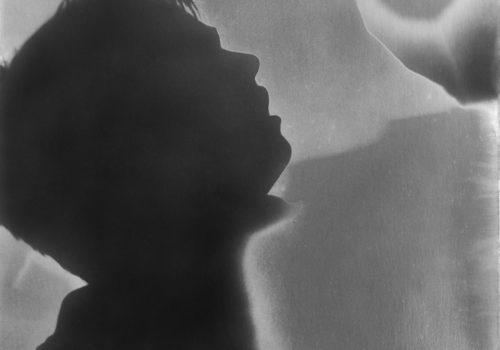
The exhibition focuses mainly on his photograms and luminograms, created without a camera in the solitude of his darkroom beginning in 1949. Guided by his principle “I am photographing the light,” Humbert worked mostly at night, experimenting with various light sources to produce what he called “images for the mind.” Using stencils, grids, and perforated cards, he generated unique, non-reproducible works in which light itself inscribed directly onto photosensitive paper. His practice probed less the visible world than what lies beyond it, exploring the very nature of luminous perception. A monumental two-meter-long print particularly stands out, its black and white traces intertwined in an abstraction reminiscent of gestural painting. Two color C-prints, rare within his oeuvre, reveal another side of his investigations.
Humbert’s late digital works, produced in his nineties, lack the intensity of his earlier analog experiments—a reminder of how complex the shift to digital can be for photographers shaped by silver-based processes. This exhibition invites a reevaluation of Humbert’s place within Swiss experimental photography. It is well worth the visit.
Art Vontobel: Collection Insights
In Zurich, the Art Vontobel collection remains little known to the general public despite being freely accessible during the company’s business hours. This openness is unusual in the world of corporate collections, which are often restricted to employees and clients. Art Vontobel takes the opposite approach, championing inclusivity. During the Swiss Photomonth, guided tours offer visitors a chance to discover recent acquisitions and gain deeper insight into the works on view.
Initiated in the 1970s with a focus on sculpture and painting, the collection shifted exclusively to photography around fifteen years ago. Its philanthropic model sets it apart: no resale, no speculation—only loans to institutions and active support for emerging artists through the Vontobel Prize, worth 20,000 Swiss francs, now in its fifth edition. Of the 450 works in the collection, 90 percent are displayed in the company’s offices worldwide.
The current exhibition presents a panorama of contemporary international photography. Among the highlights are Sheida Soleimani’s powerful photo-assemblages on migration and geopolitical trauma; Raphael Hefti’s chemical experiments that reconnect with photography’s material origins; and Jack Warne’s hybrid works combining analog processes with augmented reality to question our relationship with images. Pieces by Wolfgang Tillmans, Anette Kelm, Cortis & Sonderegger, and Vasantha Yogananthan round out this overview of photography that continually tests its own boundaries. Art Vontobel stands as a rare example of corporate collecting guided by genuine cultural philanthropy.
Maeva Dubrez
More information