Robert Capa created a style: the war photographer, eye pressed to the viewfinder, always hunting the scoop. An engaged witness, his gaze has left a lasting mark on the history of photojournalism and shaped the new figure of the war photographer.
The musée de la Libération de Paris – musée du général Leclerc – musée Jean Moulin, with the exceptional collaboration of Magnum Photos, offers a contextualized rereading of his work. More than sixty vintage press prints are shown alongside magazines, books, documents, and personal objects. Together, these 160 items trace the journey of a young Hungarian immigrant who became an icon of modern photography.
The “Capa style,” this direct and immersive way of photographing war, profoundly influenced the profession, still exposed to the dangers of the field. In 2024, according to Reporters Without Borders, fifty-four journalists still lost their lives in the line of duty, most of them in conflict zones.
By presenting Robert Capa’s work, the exhibition offers a historical view of a reality that remains urgent today: the risk taken to report on war.
The exhibition begins with the young photographer’s years of youth and exile, from Budapest to Berlin, from Berlin to Paris. In 1932, he managed to publish his first photograph in the German press. He then set out for France, where his partner and he fashioned new identities and “American” personas: they became Robert Capa and Gerda Taro, a ruse that allowed the photographer to sell their work more easily to magazines. “Bob’s” Leica camera accompanied this transformation.
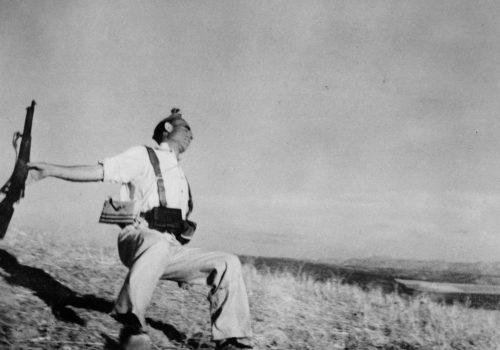
The itinerary continues with the Spanish Civil War, which the young couple joined in 1936. The legendary image of the Spanish Republican struck down by gunfire became the emblem of that war. While Capa opened a studio on Rue Froidevaux (Paris 14th), from which a typewriter, boxes of negatives, and photo notebooks remain, Gerda Taro’s death in Spain brought the carefree period to an end: tributes were paid to her in the press, and her story was popularized in the United States.
Next comes the Second World War, which occupies a central place in Capa’s career—an iconic photographer of the D-Day landings on June 6, 1944, and of the Liberation of Paris. The exhibition retraces the photographer’s movements through the capital on August 25, 1944, as he photographed the entry of the 2nd Armored Division into Paris and the fighting near the National Assembly. The following day, Capa captured the jubilation of Parisians and the final shots in the streets of the city.
After the war came the creation of the Magnum agency and assignments in a world that had regained peace in some places, but where war continued to ravage others. Until his death on assignment in 1954, Capa’s photographs reveal his determination to bear witness—in images—to the consequences of conflict on civilian populations.
This project is labeled Bicentenaire de la Photographie by the Ministry of Culture.
Curator: Sylvie Zaidman, historian, chief heritage curator, director of the musée de la Libération de Paris – musée du général Leclerc – musée Jean Moulin
Co-curator: Michel Lefebvre, journalist and photography collector
Robert Capa : Photographe de Guerre
From 18 February18 to 20 December 20, 2026
Musée de la Libération de Paris – Musée du général Leclerc – Musée Jean Moulin
4, avenue du Colonel Henri Rol Tanguy (Place Denfert Rochereau)
75014 Paris
01 71 28 34 70
http://www.museeliberation-leclerc-moulin.paris.fr
The exhibition catalogue – Robert Capa, photographe de guerre
Texts by Clara Bouveresse, Vincent Bray, Kevin Desurmont, Christian Joschke, Michel Lefebvre, Jérôme Sessini and Sylvie Zaidman
23 × 28 cm, paperback, 192 pages, 120 illustrations
Paris Musées Editions
ISBN 978-2-7596-0634-4
35 €