CASPER FAASSEN NL 1975
From his studio in Leiden, Casper Faassen works on how Western museum collections have been formed and how cultural authority has been historically constructed. “It is difficult to make sense of recent geopolitical developments without a broader historical context. In recent years, there has been growing recognition in the West of how colonial, imperial and racist histories continue to shape the present.
The solo presentation in Rotterdam forms part of Faassen’s longer running ReCollection project. Through a process he refers to as “ReCollecting”, Faassen retraces dispersed objects and reworks them in his signature language. The objects are presented as memories and placed in new groups with similar disputed backgrounds
During the fair, Faassen will present his own collection of these objects which all stand in their own corner of the conversation. A Ganesha which was returned by the Wereldmuseum to the Republic of Indonesia in 2024 stands to represent objects that have since been restituted to their countries of origin and yet still holds within accountability for past actions. While in other boxes, we see marble sculptures that continue to be prominently displayed in European museums and stand in a position of contention. Perhaps most famously the Parthenon Marbles which remain in the collection of the British Museum despite explicit requests for their rightful return.
JOOST VANDEBRUG NL, 1982
Not Yet The Image brings together new works that explore how images emerge through perception, memory, and time. Built from multiple photographs taken through subtle shifts in distance and viewpoint and assembled across cards, plates, and varied materials, the works resist instant recognition and instead form gradually through fragments and partial views.
Inspired by early photographic experimentation and Karl Blossfeldt’s systematic plant studies, Vandebrug adopts a similarly attentive, serial gaze, but turns it toward the unstable, the in-between, and the not-yet-named. Rather than presenting fixed representations, the works stage seeing as an active process: images unfold slowly, inviting the viewer to assemble them piece by piece, as if encountering the world before it settles into certainty.
ADAM JEPPESEN DK 1978
Adam Jeppesen is a Danish photographer and visual artist who lives and works between Copenhagen (Denmark) and Maldonado (Uruguay). He is known for his quiet, meditative visual language and his strongly material-based artistic practice. Jeppesen’s work moves fluidly between photography, sculpture, and installation, often created through slow, analogue processes such as photogravure, cyanotype, and anthotype. Central to his approach are themes of impermanence, trace, chance, and the slowness of artistic production.
The Tanks series, marks Jeppesen’s ongoing expansion of photography into sculptural space. In these works, cyanotype-printed silk is suspended in glass tanks filled with mineral oil, creating delicate, atmospheric objects. The tanks explore ideas of preservation
LAURENCE AEGERTER F 1972
Laurence Aëgerter’s extensive oeuvre comprises of photographic series, site-specific installations, community projects and artist’s books, addressing the permanent transformation that lies in the essence of things.
Here again history and present art practice meet. The Lithophane was developed during the first half of the 19th century in the search of the image. During a residency at a porcelain factory, Aegerter created a remarkable series of lithophanes that demonstrates her mastery of extremely thin (6 mm), translucent porcelain panels. When illuminated from behind, by daylight or artificial light, the engraved images gradually reveal themselves, appearing with a subtle, almost spectral luminosity.
The works draw on imagery from Les Archives de la Planète, Albert Kahn’s visionary early 20th-century project to create a photographic record of cultures around the world. Invited by the museum to engage with this extraordinary archive, Aëgerter reinterprets these historical photographs through the fragile medium of porcelain. In her lithophanes, memory quite literally emerges through light, transforming archival documents into intimate, luminous objects suspended between past and present
DANIELLE KWAAITAAL NL 1964
Danielle Kwaaitaal is an Amsterdam-based photographer and visual artist whose work explores the transformative possibilities of the photographic image. A pioneer of digitally manipulated photography since the early 1990s, Kwaaitaal approaches the camera as a tool for constructing images rather than documenting reality. Kwaaitaal’s practice developed alongside the emergence of digital photography in the late 1980s and early 1990s, when she began experimenting with early image-processing technologies such as Paintbox. Rather than using digital techniques to perfect images, she uses them to reinterpret reality.
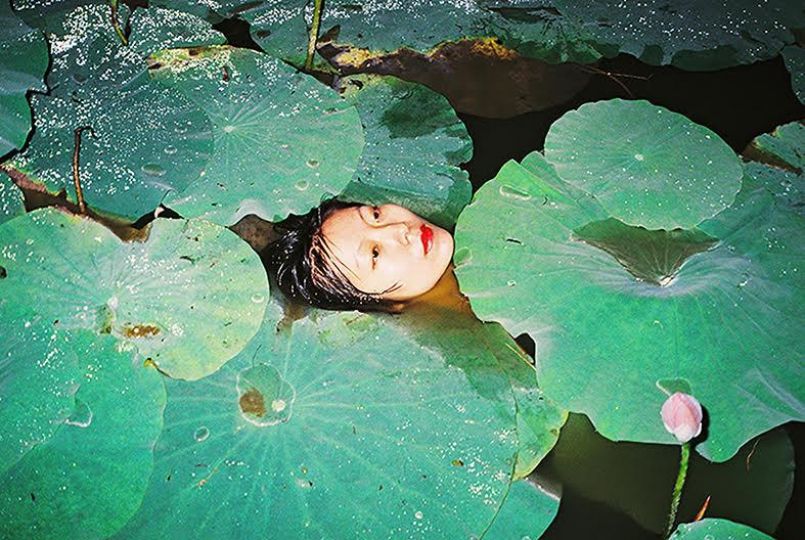
For the past decade, Danielle Kwaaitaal’s artistic practice has unfolded entirely beneath the surface of water. With her new series Silverlining, Kwaaitaal rises from the depths to return to the earthly landscape. The work marks a moment of transformation – an expansion of her artistic inquiry and a step into uncharted terrain. This shift is both symbolic and deeply personal: the artist retraces her path in the landscapes that once offered solace in her youth, while exploring how memory and perception echo, distort, and reshape one another.
PAUL CUPIDO NL 1972
Paul Cupido’s affinity for the natural world was born out of a childhood spent on the Dutch island of Terschelling, where the ebb and flow of tides and the cycles of the moon reflect the fleetingness of life.
Cupido’s work is furthermore inspired by Japanese photography as well as his travels there. Japanese philosophical principles, and especially that of Mu, permeate his creative practice. Mu could be loosely translated as does not have or a void, albeit one that holds potential. His economy of form and lyrical compositions, encompassing landscape, portraiture and still life, invite to look beyond the visible while he is rigorous in his attention to the quality of printing and his choice of paper stock. He photographs widely while traveling and reflects on the results later, which after a period of contemplation means a renewed journey of discovery, in which the intuitive editing of seemingly unrelated images leads to serendipitous combinations.
ANGEL ALBARRÁN (E 1969) AND ANNA CABRERA (E 1969)
Angel Albarrán and Anna Cabrera have worked collaboratively as art photographers since 1996. A rich inner philosophy about memory and experience – and a special curiosity for photographic chemistry – guide their aesthetic practice. Influenced by both occidental and oriental thinkers and artists, their photographs question our assumptions of time, place and identity in order to stimulate a new understanding of our own experience and perception.
Albarrán Cabrera find very interesting subjects such as time, reality, existence, identity and empathy, but what they find the most fascinating is the relation between them. These relations are difficult to explain by means of words and that is why they rely on images. Albarrán Cabrera see their photographs as objects in their own right: they personally handcraft their prints in their studio using a wide range of processes and materials. Blending elements of the Eastern art tradition with the light, colours, and moods of Western painting, they achieve a balance between the two in their prints.
MARGRET LANSINK NL 1961
In times of upheaval, clarity does not come from reacting faster, but from stepping back into stillness. Silence sharpens perception. It slows our sense of urgency and allows what is unfolding to become visible in the world around us and within ourselves. From this attentive quiet, understanding begins to take shape.
Layering is central to Lansink’s practice. Using her own photographic imagery as a foundation, Lansink builds and reworks images of landscapes and material surfaces through slow, process-based methods. Earlier states are not erased but remain embedded beneath the surface, allowing each work to hold traces of its own formation. Her practice engages with memory, perception, and transformation over time. It draws inspiration from artists such as Gerhard Richter and Lorna Simpson, as well as from philosophical and literary inquiry. Working across photography and mixed media, Lansink emphasises material presence and the quiet intensity of the passing of time.
Now in Zurich: RENATURE – INKA & NICLAS, JOOST VANDEBRUG, ADAM JEPPESEN AND DOUGLAS MANDRY ZURICH 21 March – 23 May 2026
Now in Amsterdam : JOOST VANDEBRUG – NOT YET THE IMAGE AMSTERDAM 13 March – 30 May 2026
John Devos
johndevos.photo (a) gmail.com