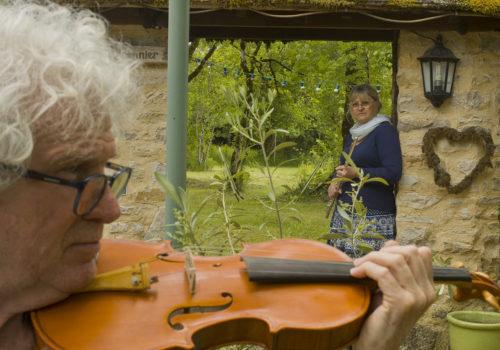
The exhibition « Cavagnac : des femmes, des hommes, un patrimoine »(Cavagnac: women, men and heritage)is a tribute to the inhabitants and to the richness of local life, seen through the lens of Donatien Rousseau. It is being held at the Bibliothèque de Cavagnac and is part of the Bicentenaire de la Photographie (Bicentennial of Photography). A catalogue with a foreword by gallerist Françoise Paviot accompanies the exhibition.
Le portrait, un art de la personne par Françoise Paviot
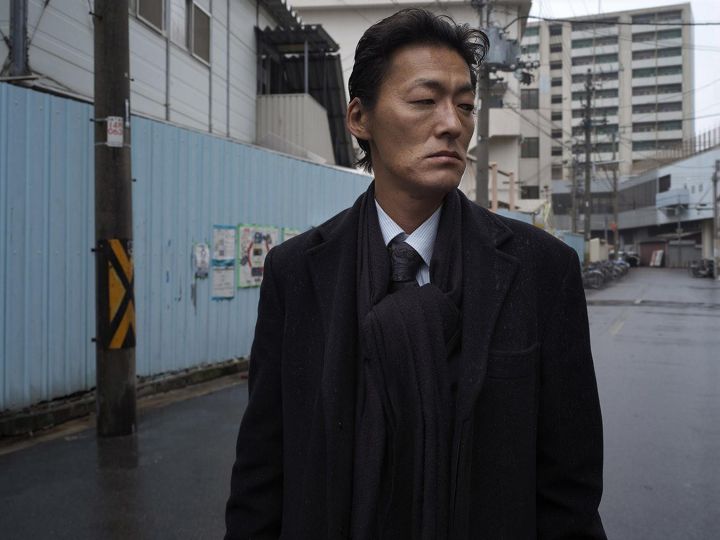
Shortly after the announcement of its invention, photography made portraiture one of its principal uses. By making, in the village of Cavagnac where he has opened his studio, the portraits of eighteen of its inhabitants, Donatien Rousseau in turn joins the line of those who have devoted themselves to this essential genre in photography.
“I did not want to stage the people,” Donatien explains, adding, “I did not want to indulge in photographic antics either.” With the same frame of mind, one of his illustrious predecessors, Félix Nadar, stripped portraiture of cumbersome props in order to avoid a theatricalisation of reality. For him, the professional portraitist was not a director and, like Donatien, he wanted the portrait to regain its primary vocation: to capture a self that is not idealised but in keeping with reality. Donatien has, however, chosen for his shots a format that Nadar did not yet know, the square format, linked to the appearance of the Rolleiflex camera in 1930. For him, the geometric rigour of this format invites the eye to concentrate so as to enter the image more fully, as opposed to the rectangular format, which scatters the gaze. From then on his framings are simple but careful and are not altered after the moment of exposure.
As a respectful and cultivated professional, Donatien does not hesitate to acknowledge his peers and here, more particularly, the photographer August Sander, who sought to convey a faithful image of the diversity of the men and women of his time. Sadly, his work was confiscated by the Nazis on the pretext that he did not sufficiently celebrate the Aryan model. With his portraits, Donatien reveals in his own way that his village of 415 inhabitants is in fact a microcosm of great diversity that reflects the reality of the world: there you meet a painter, the church volunteer, an artisan baker, two cabaret artists, a young couple and one not-so-young… Each person retains their individuality, and their image reveals a relationship built up over time, neither instantaneous nor stolen. One almost forgets the photographer, who nonetheless guarantees their presence.
Yet August Sander’s admirable photographs are all in black and white, strict and impeccable, with the attitudes of their sitters often distant and frozen. Donatien, on the other hand, works in colour, with a handheld camera and, above all, manages to create a benevolent complicity with his models, who also seem to address each and every one of us. To conclude this friendly trilogy, one cannot help but mention a third photographer, Edward Steichen, initiator of the major exhibition « Family of man »… The great family of man through which Steichen wished to convey a message of hope and brotherhood and to show that “the world, in its diversity and complexity, is one.” Far from the often artificial communication of social networks, Donatien wishes to continue this work and make it a link of mutual understanding and exchange, because faced with the overabundance of images that so often leads us to indifference, these eighteen portraits know how to make the photographic act humain again.
Françoise Paviot, 15 July 2025
Donatien Rousseau : « Cavagnac : des femmes, des hommes, un patrimoine »
Until 13 December 2025
Bibliothèque de Cavagnac
514 route de Saint-Palavy
46110 Cavagnac
06 62 71 05 65